Wednesday, 10 April 2013

Where do you feel Included? : Exclusivity in Port of Spain

"Despite the impression that might emerge from the media, contemporary cities tend to be overwhelmingly characterized by tolerance, rather than hostility, between different cultural groups." Tim Hall and Heather Barrett, 2012.


Exclusivity is a subtle but very real issue in the city of Port of Spain. It isn't something that is visible to the naked eye and one must be very observant in order to notice this. Similarly to the quote above, Trinidad is often publicized as being a multicultural nation where every "creed and race finds an equal place". However, I would say that this isn't entirely true due to the fact that people of different races do not openly disrespect each other but rather tolerate each other, especially in major urban spaces such as the city. Reason being because the city is home to several services and amenities that people need and simply cannot avoid solely because persons of different races use them as well. Few words are spoken but the tension is strong, even in public spaces within the city where no one is openly excluded, such as squares and parks, persons from various ethnic groups and economic backgrounds can be seen in pockets separated from each other.
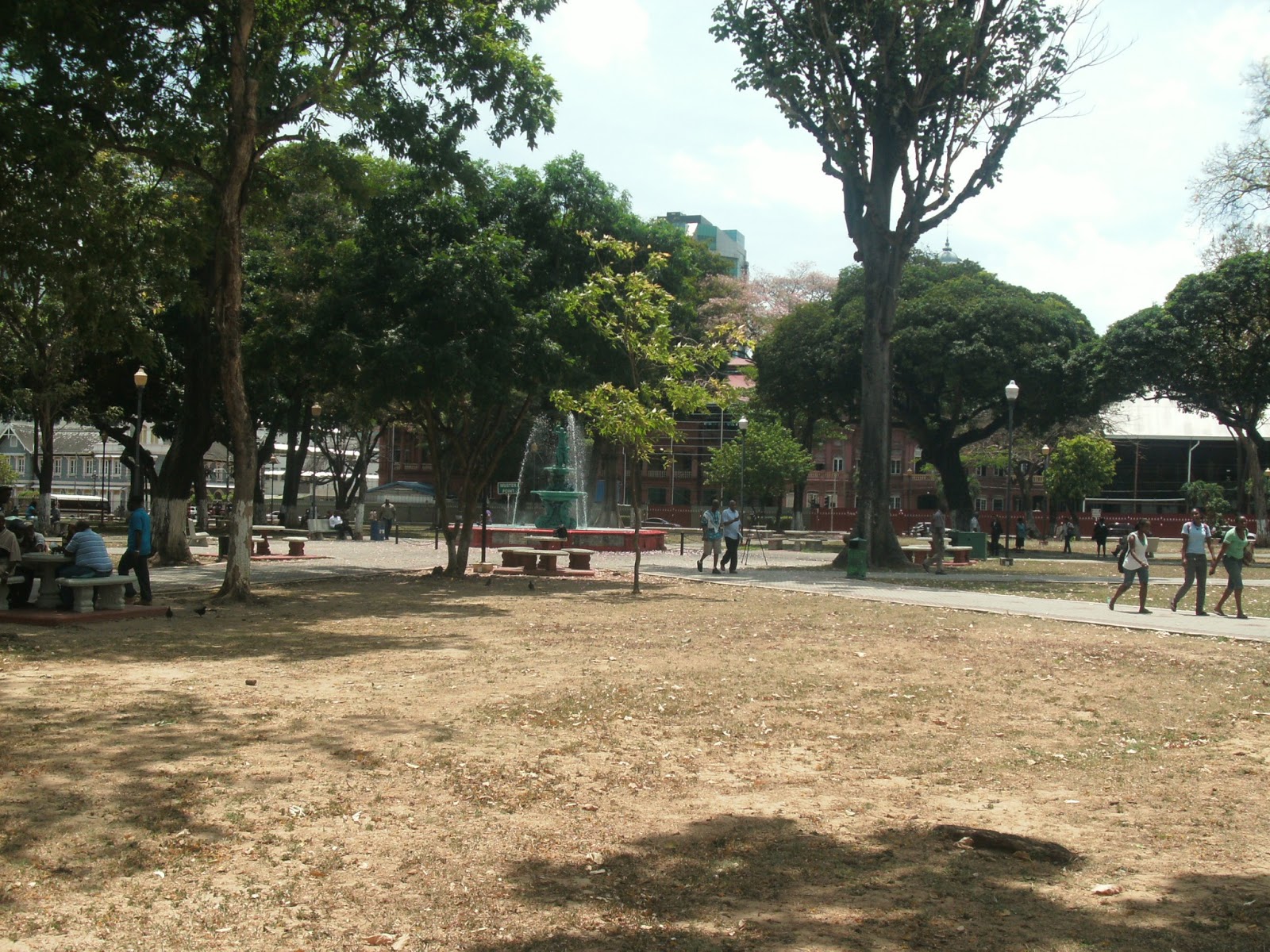
Woodford Square, Port of Spain, Trinidad.
Upon entering Woodford Square one afternoon I spontaneously decided to conduct an informal interview with a random person who was walking through the square. The conversation went something like this:

Me: Do you feel welcome in Woodford Square?
Interviewee: What yuh mean by that?
Me: Well, do you feel as though you shouldn't be here because of your race or the amount of money you have?
Interviewee: NO! Woodford Square is for everybody! It have no fight down ting (discrimination) here! And if anybody try to tell me that I cya come here is me and dem! Cuz look, it have vagrants lying down all over d square, black people and Indian people moving normal normal in here so I doe see no baccanal (trouble).
Me: That's true, I've never noticed any discrimination here either. Is there anything else you would like to say?
Interviewee: Am why you ask me that? You doing some school work or something?
Me: Yes I am actually.
Interviewee: Ok well enjoy the rest of your day eh smally this sun too hot to stand up and old talk.

 I am certain that this will be the response given by most persons who pass through Woodford Square if interviewed similarly. Woodford Square is a public park located almost in the centre of the city. It is surrounded by various shopping facilities, businesses and institutions. As a result of this the square is typically used as a pathway from one street to another or as a place of rest for tired shoppers, workers etc who walk through the city on a daily basis. It also serves as a place of recreation e.g. concerts.

While walking through the square I felt in 'place' because the atmosphere was light and welcoming. For me,  it was mainly because of the green scenery and the fact that I could hear groups of people laughing as they walked by, along with seeing several old men in clusters playing chess. There didn't seem to be any harsh sense of exclusivity taking place among the people. However, I did notice that persons walking through the square were doing so in groups of their own kind (ethnicity), similarly were the men playing chess. This strengthens the point made previously whereby in POS citizens appear to be operating in harmony but in reality are simply tolerating each other in order to maintain peace. This has always been and probably will continue to be a part of Trinidadian culture for many years to come.


One Woodbrook Place, Woodbrook, Port of Spain, Trinidad.
In comparison to Woodford Square, One Woodbrook Place is a housing development that was built up just on the outskirts of POS. This housing development was designed in a manner that incorporated several aspects of the city so that residents wouldn't have to leave their homes in order to access various services and amenities e.g. banks, groceries, stores, cinemas etc. As a result of this, the cost of an apartment/ condo in the development is incredibly high and unaffordable for most. This is a blatant form of exclusivity in the city whereby persons with high economic statuses or the 'elite class' are favoured over the middle and low income classes. In Trinidad, the elite class  is associated with white persons (although incorrect because persons of various ethnic backgrounds belong to this class) while the middle and low income classes are associated with persons of African and Indian decent. Therefore, this becomes a matter of exclusivity not only with respect to economic status but ethnic status as well. 

Although the shopping and service area of One Woodbrook Place is open to the public (public space), persons of the middle and low income classes are rarely seen shopping or using the services there. In fact, when I was walking around the shopping area taking photographs, the security guards were literally following me everywhere I walked! One of the security guards even asked me if I was a resident in a tone that to me indicated that there was no way that I could be a resident so I must be a 'suspect'. That experience made me understand why the space was so empty and eerie (in comparison to Woodford Square) on the inside despite the fact that it looks so magnificent and inviting on the outside. 

Thursday, 14 March 2013

Local Culture: An artistic point of view

Painting showing various aspects of Trinidadian culture, Queens Park Savannah POS.

To begin this blog entry I would like to reiterate the point that culture occurs on a range of scales (local, national, regional and global). Generally local culture is understood as being the term used to describe a group of persons/community who reside in a particular geographic area/place/space and share norms and values with eachother in a manner that ensures the preservation of such norms and values. This is done in an attempt to be unique and distinguish themselves from other communities/groups. From the perspective of urban geography and the geography of cities, local culture is culture that was hostorically derived within a 'tightly defined spatial scale' (Hall and Barrett 2012). In other words the local culture of a city is the set of norms and values that originated within the specific geographic area that the city covers over a period of several generations. An example of this, as mentioned by Hall and Barrett (2012), is a dialect (form of language that is specific to a certain group of persons/religion etc) that emerged historically in a particalar community and is dying out as migrants infiltrate the community bringing in new languages.
 
Trinidad has its own distinct set of cultures (local, global, regional etc) that make up its 'own' unique culture. Hence the reason the nation is often described as being culturally diverse. With respect to local culture, POS being the country's capital, is a popular place where aspects of local culture come to life. One of the major mediums through which local culture is expressed in Trinidad and Tobago is art (drawings, paintings etc.) Hence the reason the painting above caught my attention as I was walking past a local museum around the Queens Park Savannah.

The painting is actually larger in terms of length than the photograph reveals, however, within the small section of the painting that I was able to capture, there were several aspects of local culture integrated. The setting of the painting appeared to be downtown POS during the carnival season. This is evident due to the presence of feamle masqueraders in their costumes dancing and traditional carnival characters such as the Midnight Robber. Carnival is considered to be a part of our local culture because it has its roots in the Caribbean, not to mention the fact that most carnival activities take place either on the streets of POS or in various spaces and buildings within the capital. Another aspect of local culture can be seen in the titles of the local newspapers (Newsday, Punch, Express) that various persons in the painting are holding up e.g. "Guns and Amo". These all reflect the social status of the country as well as political issues that are occuring locally. Also included in the painting were important landmark buildings (buildings that identify the city) such as KFC and The Royal Bank of Trinidad and Tobago (RBTT) formaly known as the Royal Bank of Canada.

Based on your knowledge of global culture from my previous blog entry you may be asking yourself how is it that KFC and RBTT being global/ internationally owned businesses are aspects of POS's local culture. Well, in order to understand this, one should know that in all spaces of most cities elements of local and global cultures co-exist, and the key to understanding this is through looking at their interactions in local contexts (Hall and Barrett 2012). Due to the fact that the businesses mentioned have been a part of POS for so long they have been incorporated into Trinidad's wholistic culture and have therefore become accepted as being 'local'. This is a good example of how culture changes through time.


Music BREAK! :)


Here is a photo of Denyse Plummer. She is one of Trinidad's most recognised calypsonians and is most known for her beautiful song "Nah Leaving". I included the link to this song because I believe that it tells the story of Trinidad's local culture which is emanated by the city of POS. Do enjoy!

http://www.youtube.com/watch?v=Vrwcb0HXiwI

Live performance
http://www.youtube.com/watch?v=W05DLMBmv34


To conclude I would like to state that local culture in urban spaces (e.g. cities), can be incorporated into the urban landscape in several ways. To me one of the most effective ways of doing this is through the use of art in the form of paintings, drawings and even graffiti. Whether it be a beautiful mural on a building wall or illlegal graffiti on abandoned buildings, local culture can be discovered anywhere. YOU just have to be observant! ;)


Global Culture and Port of Spain

Office building located next to the Hyatt Regency, Downtown POS.

In order to understand the manner in which culture develops one should know that culture exists on a range of scales. In other words, culture occurs on various local, regional, national and global scales in different countries. This is interesting because it allows us to see that there is a complex link between cultural divesity and the spatiality of culture with respect to geographic area (scale) or location (Hall and Barrett 2012).

The photo above depicts what is to me a very important aspect of Port-of-Spain's global culture. This building is an excellent representation of modern architecture that was adopted from the modern/international cities that are continuously in contact with Trinidad, for example England, America and Canada. Given the fact that several of the persons involved in the construction of corporate and commercial buildings in POS are usually from the countries listed previously, it is easy to understand why the urban lanscape of POS is beginning to resemble that of modern cities. Not to mention the fact that upon interaction with such persons Trinidadian locals quickly adopt their behaviours and attitudes toward everyday life and the world of work. This occurs mainly because those global cultures are percieved to be 'first world' and 'highly developed' in comparison to the 'third world' and 'developing' status with which Caribbean countries have been labelled. In the future there will be several more buildings like the one in the photograph in the city of POS as the country continues to strive toward becoming fully developed.

Another important point to consider is the fact that the spaces within and around such buildings will become the breeding grounds for more globally influenced cultural activities and even locally influenced cultural activities. This is evident in and around the office building in the photograph. An example of a significant globally influenced cultural activity that took place within the spaces around the building was the 5th Summit of the Americas in 2009 at the Hyatt Regency Trinidad. The Summit of the Americas is a continuing summit that brings together the political leaders of North America, South America, Central America and the Caribbean to discuss and find solutions to a variety of issues affecting the western hemisphere. This event had a tremendous impact on the city of POS because the government of Trinidad and Tobago invested unmentionable sums of money into the infrastructural development of the city in preparation for the event e.g. paving of roads, construction of the Hyatt Waterfront etc. The event also paved the way for local cultural activities to take place in the form of displays and performances that brought Trinidadian culture to the global forefront.This shows how much of an impact global culture has on the form and structure of cities, not only with respect to infrastructural developments but also cultural developments on a local scale.

Saturday, 2 March 2013

Material Culture

Cathedral of the Immaculate Conception, Downtown POS

Let's get ready to give thanks and praise to the Lord! I am taking you all to church for a few minutes! lol :)

You may be wondering at this point, how on earth does the photograph of the church above relate to the title of this blog entry? Don't worry, I probably would have been confused myself! Before you read any further I need you to think of an answer to the following question. How might the buildings within a city reflect the culture of the people that live there?

Urban landscapes act as mediums through which persons reveal their cultural norms and values to the outside world. One of the most significant aspects of an urban landscape are its buildings. Some cultural groups are more artefactual than others, meaning that their lifestyles are directly reflected through the buildings and artefacts in the cities that they reside. This greatly influences the materiality or the nature of construction of the city, thus making cities with such features very easy to identify.

Port of Spain can be described as a post-colonial city due to the fact that Trinidad was once a British colony. During the colonial period (19th century) the urban landscape of Trinidad consisted of buildings that were strictly of British architecture. The architectural designs of churches during that period was very important due to the fact that the British were Roman Catholic. Hence the reason I took a photo of the Cathedral of the Immaculate Conception to describe material culture in POS. The cathedral was the first one of its kind on the island and it has been preserved as a symbol of Trinidad's colonial history, not to mention the fact that even today the majority of the Trinidadian population are still Roman Catholics. There are several other buildings in and around POS to date that reflect British architecture/culture e.g. The Red House, The Archbishop's House and The White House. It should also be noted that aspects of British architecture are still used in the construction of houses and other buildings in Trinidad nowadays. This just goes to show that British culture is indeed a part of Trinidadian culture and it is evident in the structural form of buildings in the city of POS.


Manufactured Culture or not?

The National Academy of Performing Arts (NAPA), Queen's Park Savannah , POS , Trinidad.

A huge mass of glass and steel glistening in the sun as it set over POS on a Friday afternoon, is what I saw as I approached this magnificent structure. I simply couldn't resist taking a picture of all its splendor. I knew its name, NAPA, but what I didn't know was what it really meant to me and not just me but the people of my country as a whole. I wondered while aimlessly standing on the pavement, hmmm........this is the home of our country's talent, the place where only Trinidad's most recognized cultural kings and queens perform and show off all that our history has to offer! Suddenly, I felt an overwhelming urge to go inside! However, before I could make another step someone startled me by saying, "Look at dat waste of meh tax money! Hmph! All dat money spend just to make we look bigger on d world map! We already have Carnival wa we need NAPA for??". Hearing those words juggled my thoughts. What on earth did he mean by saying that? Do you know?

When thinking about culture in any city it is often quite noticeable that some aspects of culture are manufactured and manipulated by the government of a country to achieve some sort of economic or social developmental profit. In the case of NAPA, most Trinidadians see the building itself as Trinidad's most significant entertainment center with its outstanding architectural design and appearance. Persons involved in major cultural activities, for example, calypso and soca artistes, folk dancers, carnival mas designers etc see NAPA as a place of opportunity to become recognized regionally and internationally. It is because of this I strongly believe that NAPA is an example of how culture can be manufactured. NAPA was constructed in the city of POS not only to promote Trinidadian culture but also as a strategy to ensure 'economic dynamism' (Hall and Barrett 2012). Economic dynamism can be described as the changes that take place in an economic system, especially those reflected in the markets, businesses and the general economy of a country (Business Dictionary 2013).  For those of you who are ignorant, Trinidad's economy is largely based upon the natural oil and gas industry as well as other aspects of international trade. Hence the reason the decision to diversify the country's economy via developing the cultural sector was made. With the creation of a cultural economy, the country's general economy is boosted through local and international persons spending money to visit NAPA to see cultural shows and displays. Carnival already plays a major role in Trinidad's cultural economy by generating enormous profits through tourism, therefore the addition of NAPA to the economy has only made it more lucrative.


Explore the links below for some additional information about The NAPA and how it is intended to enhance the economic, social and urban development of Trinidad and Tobago.


Sunday, 17 February 2013

Cultural Other

A view of the hills of Laventille from downtown Port-of-Spain
The "cultural other/s" of cities are often described as the things or groups of people that are routinely demonized in the public's or media's eyes (Hall and Barrett 2012). In other words, these are the things that stir up fear or create a sense of weirdness in the minds of the majority who think of the city in question. There are several cultural others in the city of POS. However, the most prevalent would have to be crime and not only crime but the persons who are responsible for it as well as where they are believed to come from.

Laventille is an urban settlement that is located directly on the peripheries of POS. This settlement is believed to have been formed as a result of persons wanting to live close to the city informally (squatting) for various reasons e.g. job opportunities etc. As a result of their often poor living conditions and their struggle for survival many of the youths from Laventille began to form gangs to steal from the affluent people of the city. This trend continued for years and still continues today, hence the reason most men, if not every man from Laventille is stereotyped and feared by most Trinidadians. Do you believe that this is fair though? It is through this that the hills of Laventille, as shown in the photograph above, can be used to reflect a cultural other of the city of POS. Bear in mind that although Laventille poses as a cultural other it contributes significantly to the form of POS.

How do I reflect on this photograph being a Trinidadian you might wonder? I'd simply say RUN!! IS LAVENTILLE UP DEY YUH KNOW!! However, from an urban geography perspective, I'd look at how cramped and unplanned the settlement looks, instinctively I would think of it as being a low end settlement or   somewhat of slum -type dwelling. Upon seeing those types of settlements I would imagine an unhealthy environment of crime, disenchantment and despair........the lack of basic utilities and services such as water and proper sewage management. Perhaps my reflection is biased for it is within a similar culture of that of Laventille that I have grown up and been exposed to. So I know what the culture of the 'other' feels like or may be perceived to be.
Now tell me, what do you think?


Take a look at the video in the link posted below. I believe that it gives some insight as to how the 'perceived' culture of persons from Laventille makes them the 'cultural others' of the city. Police brutality is being inflicted upon some residents for no apparent reason. (Please pardon the obscene langauage)


Cultural Aura

Photo was taken at the Brian Lara Promenade showing night clubs and persons " liming"

At this point you may be wondering what is cultural aura. Well, this can be explained as the most popular aspect of a city with respect to its culture, or perhaps the most dominant practices of the people that live within the city or come into contact with the city on a regular basis. In other words it is the 'aura', the most popular aspect of a city, what first comes to mind when you think of that city, the highlight of the city (Hall and Barrett 2012). The photo above captures, what is to me, the cultural aura of Port-of-Spain (POS). On a typical Friday evening or any evening for that matter, Trinidadians can be seen in clusters throughout POS "liming" or hanging out on the Brian Lara Promenade. The photo also shows the presence a night club and casino (Club Princess and Deuces Night Club & Bar) within which people can go to "lime" and have a good time. Cutting to the chase, the liveliness of the city stems from the love that Trinidadians have for liming which has led to the construction of various liming spots or night clubs, bars, casinos etc that contribute significantly to city's urban landscape.

With respect to how the city functions, this aspect of Trinidadian culture allows for the formation of businesses in the form of popular liming spots. This encourages persons who seek such entertainment to come to POS frequently, thus generating funds for business owners and by extension contributes to the country's GDP. It also ensures a constant influx of people to the city who will not only spend money on clubbing and partying but also on the other services that the city has to offer such as the transportation system.